Gdynia was the pride of the II Republic of Poland. The only big city built from the beginning to a complete town of 100 000 before the II World War within ten years. It came into being thanks to the harbour that Poland needed due to a very complicated political situation in the neighbouring Free City of Gdańsk (Freie Stadt Danzig), where theoretically, under the provisions of the Peace Treaty in Versaille, Polish ships were supposed to be stationed. Yet the German authorities always made it difficult. The harbour was started in 1922 and in 1926 the once fishing village of Gdynia was given the city charter.
Given 123 years of Poland's non-existence on the map of Europe from late 18 c. to the end of I World War, the rebirth of the country was a celebration to all the nation. Immediately, the Navy was established to guard the narrow access to the Baltic Sea, the so called Polish Corridor. And soon, the biggest and most modern harbour started to emerge. People flocked from all over Poland to contribute to that national investment making the country independent; boosting the trade and businesses.
The construction of both the harbour and the city was subject to the then dominating modern style, Modernism or Art Deco. All the buildings were white or at least light in colour, had very characteristic rounded corners, windows set closely to one another looking like in a ribbon, vertical elements, wavy and corner balconies. The streets were planned as wide and straight passages and the promenade leading into the sea was designed at the end of one of the main streets.
 |
| The city plan |
 |
| the Art Deco architecture |
 |
| The Marina |
 |
| The harbour |
 |
| InfoBox opening the view over the scenic promenade into the sea: |
 |
| The favourite venue for passtime |
Before the war there were two competing seaside resorts: Sopot, making part of the Free City of Gdańsk, and just over the border - Orłowo, part of the Polish Gdynia. Both had wooden piers, which remained until today, and beaches. Sopot was much bigger and well known, while Orłowo - despite its slightly more local character - was specifically popular with Poles who made it a point of going to Poland for summer holiday.
Today's look of Orłowo is pretty much the same as the original style - all built in white. The Cliff is still there, the few fishermen and the pier.
 |
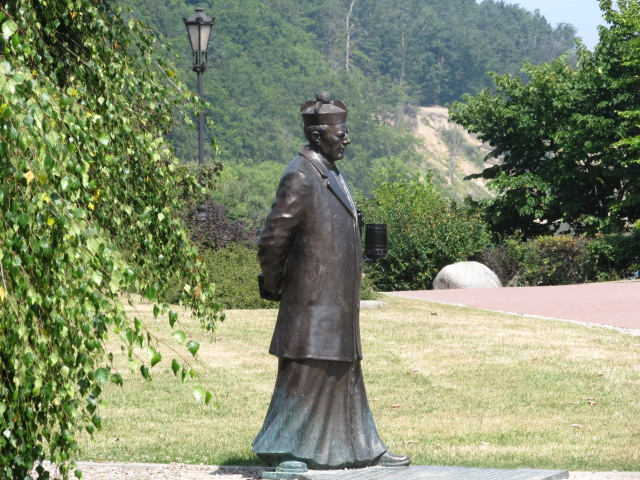
| Thew priest of the local parish church, much loved by his congregation |
 |
| This Air General died in a plane crash next to the pier while showing off in front of his wife waiting for his return |
 |
| Who is sitting here? |
 |
| A well known painter - Antoni Suchanek |
 |
| The Polish writer, Stefan Żerowmski used to spend time here in Gdynia writing his novels, among the "The Wind off the Sea" |
 |
| The latest arrival in the area, a business centre in rhe main street |
.JPG)
.JPG)
.JPG)


.jpg)